


Or more accurately, emotions are all vital.
When you get down to it, every emotion is just an amoral messenger. That means that no single emotions is inherently “morally good” or “morally bad,” they’re just neutral. And each one is a messenger trying to tell us something important.
But we rarely listen to what they’re trying to tell us, and even less often do we react in a constructive way. Instead we have deemed some emotions as “good,” and others as “bad” that should be avoided at all costs.

We openly encourage, celebrate, express, and socially validate “good” emotions like happiness, excitement, surprise—even fear can be a fun experience (horror movies, scary rides). We like all those feelings! And honestly, if asked, we would all probably want to experience only those emotions—the ones that feel good. Duh.
…And then there are universally shunned emotions; those “bad” feelings that we’d rather not feel, like sadness, anger, jealousy, or disappointment. And if we do feel them, we rush to stop feeling them–often through various numbing and distracting tactics like drinking, shopping, swiping, etc. Pick your poison.
I can’t really blame anyone for turning to those coping mechanisms, and I also have my own vices I resort to from time to time. After all, we are biologically hardwired to seek pleasure and avoid pain. Most sentient life forms are. But that’s not an excuse from pursuing self-awareness and responsibility for our own regulation.
But that doesn’t take away from the fact that when you’re actively feeling any of these “negative” emotions, it is not an enjoyable experience. At all. In fact, it’s often very painful, or at the very least, uncomfortable. It doesn’t feel good.
But what if I told you that all emotions—yes, even the not-fun ones—are actually good, in a weird way?
What if the entire spectrum of emotions is necessary to fully experience your time on earth? That they serve an important purpose and shouldn’t be rejected outright?
Let’s get into it.
All Emotions Are Important
Yes, all of them. Think about your body and all the various organs contained within it. (If you ever get a chance to check out Body World’s plastinated displays in your city, I highly recommend it! Definitely gives you a new appreciation for the biological machine you inhabit.)
Let’s take, for example, your large intestine.
Bowels might seem kind of gross because of what they do (and what comes out of them!), but they’re extremely important to your survival. It’s a dirty job digesting food for your body and ridding it of its waste, but somebody’s gotta do it!
If your large intestine was gone, you’d severely miss it and your quality of life would be drastically different. And that’s just one organ! They’re all so different and do so many different things, and every single one is important and useful to our survival.
Emotions are no different, except the vital function they’re performing is less obvious than our digestive track, because emotions are just messengers.
Let’s look at a common, yet often problematic emotion like anger. Anger’s message is usually about a boundary being violated. Healthy anger wants to protect you physically and emotionally. If someone is screaming at your and acting aggressively, your natural response would be to feel angry in return.
You’d get a flood of adrenaline, your heart would beat faster, and blood would rush to your arms and legs so that you’re ready to fight, or flee, if needed. If nothing ends up happening, you’re left feeling agitated and on edge for a while.
Another, more every-day example would be is if your mom keeps coming by your home (unannounced) even after you’ve told her (multiple times) to call first. Your frustration is letting you know she’s not respecting your boundaries, and it’s trying to motivates you to do or say something about it. The anger is telling you that there’s a problem and you need to address it ASAP.
Now, emotions—especially volatile ones like anger—can absolutely be used to do destructive things. But that’s not the anger’s fault. The anger is just a messenger alerting you to a perceived threat.
It is up to each of us to accept personal responsibility with what we choose to do with that info.
Now, what about those instances when people get angry without a clear violation of boundaries?
Often anger can be a cover for emotional pain. Instead of protecting against physical safety risks, anger is given the job of protecting the ego. I see this in a lot in male clients.
Men, generally, have been conditioned to not express any strong emotion besides anger. In fact, anger has been successfully rebranded as Not An Emotion.™ Everything else gets suppressed; all the pain, the sadness, the disappointment, the heartache, the joy, the vulnerability, the shame. All of it, buried deep down.
Here’s the kicker: suppressed emotions don’t go anywhere. More and more we’re realizing that the feelings we resist just stay stuck inside our bodies and eventually cause health problems. Emotions have to be expressed. They are literally energy in motion: e-motion. And these powerful energies have to be moved out of the body, in one way or another.
People who suppress their emotional pain and shield it with anger will usually have unpredictable outbursts of rage.

The tiniest little thing will set them off. Like when your dad yelled at you for not putting the dishes away correctly. People like that have created a volatile volcano within themselves that can erupt at any time, which ends up harming themselves and others. This is what happens when emotions are ignored. You as a kid didn’t do anything “wrong” in that instance, no real boundary violation took place. But your dad still exploded in anger as if you stole his car and crashed it.
It is important to discern that not all emotions are always a healthy response or appropriate to the situation—not to discount anyone’s lived experience. Let me explain.
Just because we are recognizing all emotions, even anger, as “good,” doesn’t mean we get a free pass to express them indiscriminately, over anything.
This is not an excuse to erupt at anything that offends, like if your ego was bruised. How many people do you see get into a rage over some someone’s comment on social media? Often that instance of rage is simply communicating that their pride took a hit, which isn’t really a big deal in the grand scheme of things.
All Emotions are Good?
As I’ve mentioned earlier, all emotions are actually amoral—they just are. Neither good nor bad in the moral sense. It’s what we do with them that determines how beneficial or detrimental they are. Even a negative feeling like anger can spur action. Think about how many times throughout history, that progress was only made after some incredible injustice. When we witness injustice, we get angry, but for a righteous cause. People protest, march, boycott. Change takes place. That is good.
Remember, healthy anger is trying to tell you that something has wronged you or others. That’s it. You then get to choose whether you’re going to react violently in the moment, or respond in a measured way. Perhaps even expel the initial rage safely first, which we’ll cover in a separate article.
But, why are some emotional experiences so painful, if they’re “all good?” Sure doesn’t feel good—going through a breakup is no walk in the park. Totaling your car sucks. The death of a family member haunts. The grief of losing someone close can feel unbearable, as if your actual heart is being ripped out. (During heartbreak, your physical heart can actually feel pain similar to a heart attack, called Broken Heart Syndrome. Taking an NSAID can help the pain of heartache, believe it or not.)
I would say painful emotions like sorrow are still “good” because they can be a catalyst for growth and meaning.
Whenever someone goes through any kind of loss, once they come out of the initial grieving process, they are faced with the decision to stay stuck in the ashes where they are, or to rise up from it and move forward. Stagnate or grow.
Looking back on my own life, through the lens my own losses, I can see now how they were good for my personal growth. But at the time I wouldn’t have said that.
Life’s hardships shaped me into who I am today. Stronger, wiser, more empathetic. As painful as they were, I can’t deny that I ultimately am better for it. I’m choosing to trust that those dark times were the only way I could learn those particular lessons.
Another way to think about it is to compare difficult emotions and experiences to resistance training. It might not feel good while you’re in the gym, in fact your muscles will probably hurt like hell the next day, but you still do it, for your future self. Because you know that it’s actually beneficial for your health to go through this specific pain. While a broken heart is many more degrees of suffering, the result is the same. Like it or not, adversity breeds character.
As much as you can, try to see emotional pain as an opportunity to learn, to grow, to build resilience. We need resilience to survive and thrive in this harsh world.
A butterfly struggles massively to escape its cocoon. But the struggle is important to its wing development. While the butterfly might, in the moment, appreciate a good Samaritan helping them out of their chrysalis, in actuality the helper is ensuring that the butterfly will not be able to fly, and thus, survive.
Our painful emotions offer us wisdom and depth, a way to tether the heights of our pleasure to the groundedness of reality. The constant interplay between bitter and sweet from which we derive meaning and inspiration. Yin and yang. There is light in the darkness and darkness in the light.
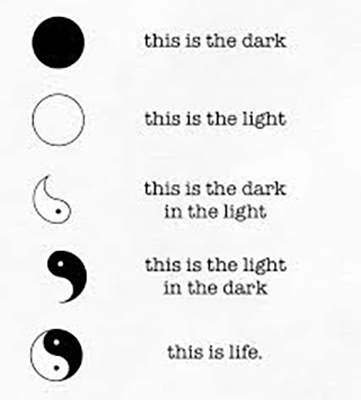
The pain of the human exprience is often transmuted into great art, reflecting the truth that creation can only arise from the void of destruction.
Ever meet someone who was born with a silver spoon in their mouth and never had any hardships? They are usually shallow, spoiled, and entitled. Pain is very humbling. Like everyone else, I’d rather not feel rage or sorrow. Certainly not more pain. But to deny these heavier emotions outright is to deny your own humanity.
All Emotions are Necessary
Every single emotion is necessary to get the most bang for your buck as a human.
Imagine you’re a soul getting ready to board for earth. They give you a build-your-own-earth-experience menu, in which every single human emotion is presented on a spectrum, with all the “good” ones on the left, and all the “bad” ones on the right side.
Imagine you only circled the emotions on the left.
You’d essentially be getting only half the ride. And dare I say…you’d only be experiencing the shallow end of a dream.
Now imagine returning from said trip and sharing your insights of that narrow version of human existence with your soul tribe. They might say, “Sure, it must’ve felt nice, but what did you learn?” “Wasn’t it one dimensional, kinda boring?” “What was the point of that trip?” It’d be like bowling with the bumpers on. Without risk there is no real reward. The victory feels hollow.
And then all your spirit buddies would flock to the entity who just got back from an Indiana-Jones-type adventure. Danger, excitement, highs and lows, but in the end they succeeded! You could make a movie out of their life.
This is why The Empire Strikes Back is so universally loved and highly regarded. It perfectly encapsulates the struggle between light and dark, good and evil. There’s highs, there’s lows, there’s love, loss, pain, challenges, victory, and loss again. Things get really dark and heavy. And we love it.

Another way to look at it is through the frame of gratitude, and how the full variety of emotions ensures we remain fully present in the moment and enjoy all that we have, when we have it. Everything in life is fleeting. The good and the bad.
We humans are silly creatures: how often do we take things for granted when it’s all smooth sailing? But once those little luxuries and necessities are taken away, we feel the pain and longing of that loss. Often quite sharply. It’s a reminder to be grateful, no matter how small or insignificant something may seem.
Like a not-sore throat. You probably don’t even notice that you have a throat most days, right.
Until you catch a cold.
I’m still on the fence about which one’s worse—a sore throat or a congested sinus. Would you rather
A) Not be able to swallow (or)
B) Not be able to breathe?
Hmm…Afrin is a thing and it works immediately. I have yet to find a spray that provides actual, lasting relief for a sore throat, so I think I have to go with (A) as being the worst. Because hotdamn, when that puppy goes out you KNOW about it…and it won’t let you forget it, either.
When you get a cold or flu, you are painfully aware that you have a throat, and that it’s very raw, and scratchy, and you would give anything to have it be not-sore again, just for a few minutes even. You forget the bliss of being unaware of its existence, because now, it’s all you can think about. And it hurts.
That’s the power of painful experiences and emotions. Perspective.
Without these periodic heartbeats of loss, we’d be cruising mindlessly through life, without appreciating all that we have.
We already do that a lot anyway, which is why it’s so important to strive to have a spirit of gratefulness.
If you want less pain and hardship in your life, always be thankful. Appreciate everything to the fullest, even annoyances like traffic. It could always be worse. Instead of saying, “I have to pick up my kids,” say, “I get to pick up my kids.” Just imagine if your legs were severely injured in a collision, and you could no longer drive, let alone walk.

You’d look back fondly on when you used to sit in traffic. You’d wish you could go back, and get up early, get dressed, and leave when it’s freezing cold out so your daughter’s not late to class. If the ability to drive was taken away from you, you most likely would miss all the things you used to complain about regarding it. Yes, even bumper-to-bumper.
This is why the pain of loss is sometimes necessary, to remind us. It’s a tough pill to swallow but it’s there for us.
Emotions—So if They’re All Good and Valid, What Do We Do With Them?
Now that we have an understanding (and appreciation) for all emotions in their many forms, what do we do with them? Because as we’ve already learned, an emotion is energy and it needs to move out from you. But how?
Keeping it in is not a healthy option, and doesn’t really work anyway. But how do you dispel a notoriously violent emotion like anger in a way that is not harmful? What do you do with overwhelming fear or crippling anxiety?
Find out in our follow up article, Emotions—They’re All Good: Part Two.